
Here is the thing almost nobody tells you before you go. You do not have to pay to see the Giant’s Causeway. The stones sit at the end of a public right of way, and walking down to them costs nothing. The sixteen pounds is for the visitor centre and, more to the point, for somewhere to put the car.
That is not me telling you to dodge a fee. The National Trust does real work here and the exhibition is decent. But you should know the choice exists before you are standing at a ticket desk assuming you have none, because plenty of people pay for a building they then walk straight past.
Some links in this guide are affiliate links. If you book through one I may earn a small commission, at no extra cost to you. As an Amazon Associate I earn from qualifying purchases. I only link to things I would use myself.
Driving the coast? Here is the whole Causeway Coastal Route on one map, Belfast to Derry, with every stop and what each one charges.
Giant’s Causeway tickets: what it costs in 2026
The Giant’s Causeway Visitor Experience is £16 for an adult, £8 for a child aged 5 to 17, free for under fives, £40 for a family of two adults and up to three children, and £24 for a single adult family. National Trust members go free.
That ticket buys reserved parking on site, a guided tour, a hand-held audio guide in one of eleven languages, the exhibition, and use of the shop, café and toilets.
If you have National Trust membership, take it with you. It covers the parking and the visitor centre, and it is worth doing the sums before you travel, because Carrick-a-Rede and Downhill and Mussenden Temple are all National Trust as well. Two or three stops along this coast and a membership has paid for itself in a single day.
Everyone has to book ahead now, National Trust members included. That caught a lot of people out when it came in and it still does. Turning up on spec at eleven on a July morning is how you end up parked in Bushmills.
Flying from the US?
Most Americans pay too much to get to Ireland.
I send one email a week with the best fares from US airports into Dublin, Shannon and Belfast, plus what to actually do when you land. $14.99 for the year, refunded if it does not pay for itself.
Is the Giant’s Causeway visitor centre worth paying for
I have just spent several paragraphs explaining how to do this for nothing, so let me be straight about the other side. I would pay for the visitor centre.
It is genuinely informative. If you want to understand how the stones got there, and what has gone on along this coast, you will come out knowing a good deal more than you went in with, and the audio guide is a nice touch. It does not eat your day either. Half an hour will cover it, maybe an hour if you are the sort who reads every panel and watches everything, which I usually am.
So here is how I would put it. The stones are free and always will be, and if money is tight you lose nothing by walking down and standing on them. But if the history is part of why you came, the ticket earns its keep.
One warning nobody gives you. There is a bit where you look through something and all of a sudden the giant is there. It gave me a wee bit of a scare and I was not expecting it at all, so consider yourself warned.
Giant’s Causeway parking, and the free route
The path down to the stones is a public right of way. You can walk it without a ticket and nobody will stop you. What you do not get is the car park.
So the honest version is this: the Causeway is free, and access to it is effectively priced through parking. Your options:
- The Causeway Coast Way car park, £12 a vehicle, free for members. Cheaper than two adult tickets, so for a couple it already makes sense.
- Park and ride from Bushmills, which is the sensible move in summer.
- Walk in along the Causeway Coast Way if you are already on the coast path. This is the genuinely free version and by far the best way to arrive.
That last one deserves more than a bullet point. Coming at the Causeway along the cliff path rather than out of a car park is a completely different experience. You see it the way it deserves to be seen, from above and from a distance first.
Getting down to the stones
It is about a mile from the visitor centre down to the Causeway itself, on a tarred road. Downhill on the way there, which means uphill on the way back, when everyone is tired.
The Translink shuttle bus runs that stretch for £1, or €1.20, each way, and is free for members. With small children, dodgy knees, or simply no appetite for the climb, it is a pound well spent. Nobody is judging you.
Do the clifftop walk, not just the stones
This is the bit most people miss. The great majority walk down the road, stand on the stones, take the photograph and walk back up the same road, and that is the whole visit.
There is a better version. From the stones you can carry on and climb the Shepherd’s Steps, 162 of them cut into the cliff, and come back along the top. That is the National Trust’s Red Trail, about two miles all in, and it puts you back at the car park without retracing a step.
The views from up there are the ones worth having. You get the Grand Causeway laid out below you, the viewfinder at Weir Snout, and a proper sense of the scale of the headland that you simply do not get standing at sea level among everybody else’s elbows.
Fair warning on the steps. They are steep, uneven and of varying depths, there is a handrail but the cliff edges up top are unfenced, and it is not the walk to do in a gale. On a good day it is the best hour on the whole coast.
The Wishing Chair
Down among the columns there is a natural seat, worn smooth by a few hundred years of backsides, known as the Wishing Chair. The tradition is that a wish made sitting in it comes true, and it is said to have been Finn MacCool’s own chair when he was a boy.
You will usually find a small queue for it, and it is worth joining. It is one of the few bits of the place you can actually interact with rather than photograph.
Eating: bring a picnic
There is a café in the visitor centre and it is perfectly good. If you are stopping in, my order is a fifteen, the marshmallow traybake you will see in every café in the north, because I love the ones in there. Failing that, the raspberry and white chocolate scone. But my honest advice for the whole Causeway Coast is still to bring a picnic.
There are tables up at the top and grass outside the visitor centre, and if the weather is behaving that is a far nicer lunch than queueing indoors. We have stopped in Bushmills and eaten ours there on the way. There are plenty of wee cafés along this coast if it turns, so you are never stuck.
The reason it matters more than usual here is the coaches. A full bus emptying into a small town creates a queue in every single place at once, and if you have arrived on one of them you are in that queue with everybody else. A picnic takes you out of it entirely.
If you are not driving, take the tour
There is a full guide to Giant’s Causeway tours here, covering Belfast and Dublin departures, what is included and when driving yourself is the better call.
I have done one of these and I would recommend it without hesitating. The day tours from Belfast bundle the Causeway with the Dark Hedges and the castles along the coast, which is a sensible way to see a stretch of road that is honestly nicer to be driven along than to drive.
The trade is that you are on somebody else’s clock. You will get an hour or so at the stones, which is not long enough for the clifftop walk. What you get back is a guide who knows the place, who will point out every Game of Thrones location along the way and give you a pile of history you would never have got on your own, and a whole day of sitting and looking out the window instead of watching for the next turn. On this coast that is a fair swap, and if you have decided against hiring a car I would take the tour every time.
I brought a picnic on mine and I would do that again.
If you are driving, build in the stops
The mistake is treating the Causeway as the destination and the road as the bit in between. The road is half of it.
Dunluce Castle is ten minutes along the coast and worth pulling in for on its own, a ruin on a headland with a sea cave running underneath it and a drop on three sides.
Ballintoy Harbour is the other one I would not skip. A tiny working harbour at the bottom of a steep twisting road, and one of the prettiest few minutes on the whole coast. Beyond those two there are viewpoints and pull-ins the whole way along, most worth five minutes, almost none of them signposted as anything much.
When to go
Early or late. The coaches start arriving about ten, and the middle of a summer day is genuinely unpleasant, with people queueing to stand on the famous stones for a photograph.
It is open country and the coast path is there whatever the hour, so first thing is the answer if you can manage it. Out of season is better again. A bright day in October or November gives you the same rocks with a fraction of the people, and better light.
Wrap up regardless. It is a north-facing headland on the Atlantic and there is nothing between you and Iceland.
The story, and the other story
The one you will be told is Finn MacCool, the giant who built a causeway across to Scotland to fight Benandonner, got a look at the size of him and legged it home. His wife Oonagh dressed him as a baby, Benandonner saw the size of the child, worked out what the father must look like, and tore up the causeway behind him as he fled. The matching columns at Fingal’s Cave on Staffa are the Scottish end of the same formation, which is the detail that makes the story land.
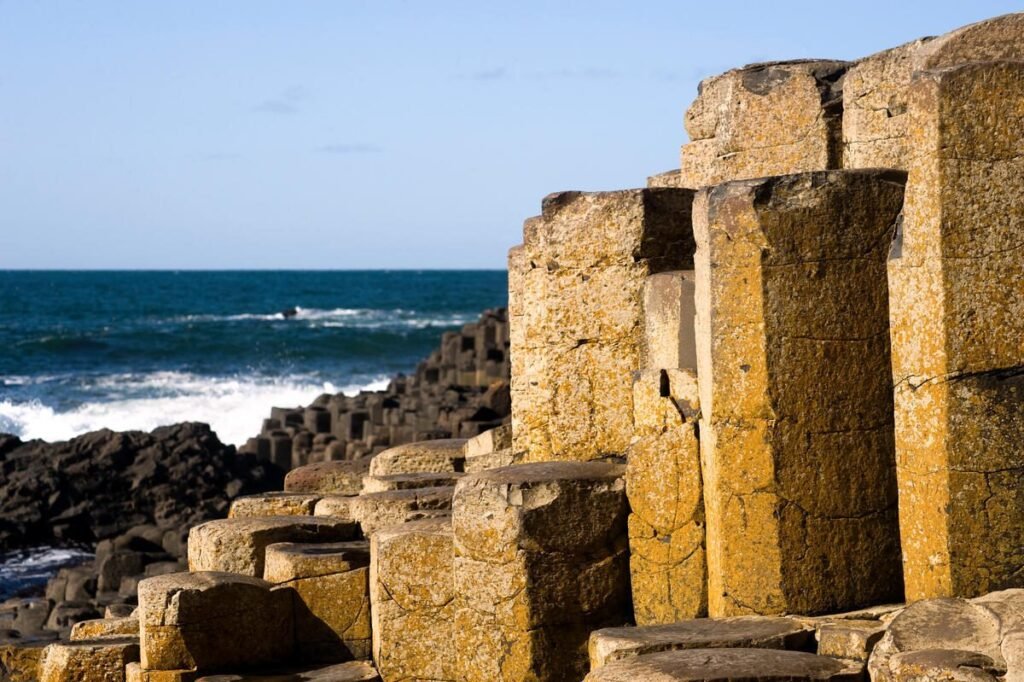
The other is that about sixty million years ago lava cooled slowly and cracked into columns, the way drying mud cracks into plates, and that hexagons are simply the most efficient way for a cooling surface to break. There are roughly 40,000 of them.
Both are worth knowing. The geology does not spoil the myth and the myth does not soften the geology.
While you are up that way
The Causeway is about forty minutes from Derry and an hour from Belfast, and it anchors a coast you could easily give two days to. Bushmills is five minutes away. The full guide to things to do in Northern Ireland covers the rest of the coast, the cities and the mountains.
If you are coming up from Donegal or heading that way after, the guide to crossing the Irish border covers the currency, the speed limits and the hire car insurance trap, which catches more people than it should.
Where to stay
Most people do the Causeway from Belfast or Derry. Both work, and Derry is closer and cheaper.
Belfast
If you are planning an evening out, stay in the city centre. Taxis and Ubers in Belfast are harder to come by than you would expect.
- DoubleTree by Hilton Belfast City Ten Square. Directly behind City Hall, so everything is a short walk. It was Ten Square before the Hilton rebrand.
- Bullitt Hotel. Cathedral Quarter, better value, and you are already among the bars and restaurants.
- Titanic Hotel Belfast. In the old Harland and Wolff drawing offices. I stayed here and really liked it, but it is not right in the middle, so take it when you are not planning a night out.
Derry
- Bishop’s Gate Hotel. Inside the walls, in the old Northern Counties Club. Named Hotel of the Year 2026 at the Ulster Tatler Awards.
- Shipquay Boutique Hotel. Also inside the walls, small, everything on the doorstep.
- Maldron Hotel Derry. Central, reliable and usually the cheapest of the three.
Frequently asked questions
Is the Giant’s Causeway free?
Yes, in that the stones are at the end of a public right of way and you can walk to them without a ticket. No, in that the car park is not free and most people arrive by car. The £16 visitor ticket includes parking.
Do I need to book?
Yes. Everyone is asked to pre-book, National Trust members included.
How long do I need?
Two hours to walk down, look, and come back. Half a day if you take in some of the cliff path, which you should.
Is there a bus down to the stones?
Yes, the Translink shuttle, £1 or €1.20 each way, free for members.
Can you walk on the stones?
Yes. They are wet, uneven and slippery, and people turn ankles on them every year, so mind yourself and wear something with grip.
Pin this for later
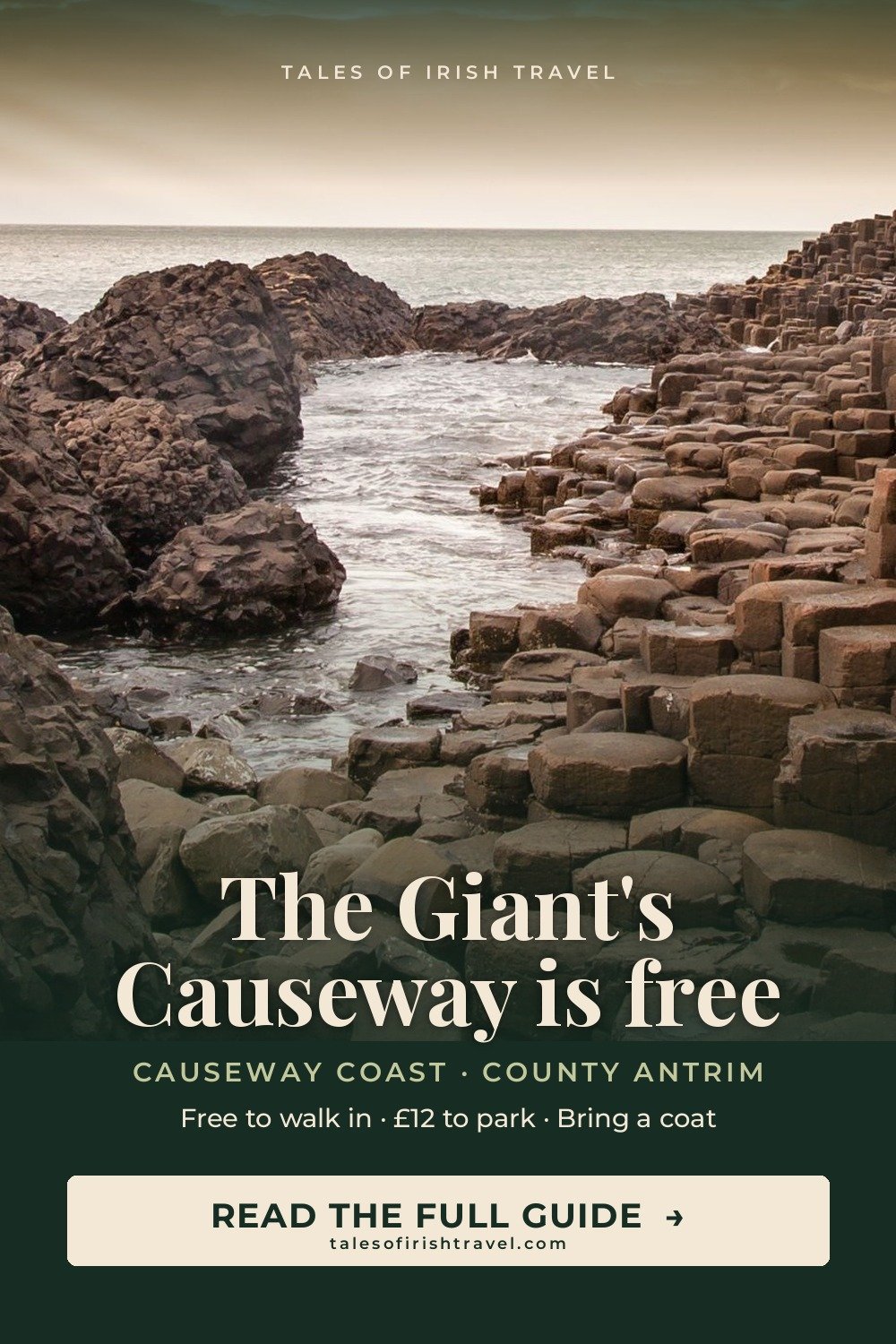
Planning a trip? Save this to Pinterest so you can find it again.

Written by
Diana Greenlee
I live in County Down and write Tales of Irish Travel. After years living abroad I came home during Covid and started properly exploring the island. I write about the history and the story behind a place, not just the place. More about me.