
Not everything in Inishowen needs boots and a weather forecast. Glenevin is a short, well-made gravel path up a wooded glen to a waterfall, it takes under an hour, and small children manage it happily. If you have spent the morning white-knuckling your way over Mamore Gap, this is the antidote.
Working out where this sits against everything else on the peninsula? It is a pin on my map of Inishowen, alongside every other place worth stopping at on the Inishowen 100.
Some links in this guide are affiliate links. If you book through one I may earn a small commission, at no extra cost to you. As an Amazon Associate I earn from qualifying purchases. I only link to things I would use myself.
One trip, two jurisdictions. Euro on one side, sterling on the other, and a few things worth knowing before you drive across. See the Irish border guide.
The glen
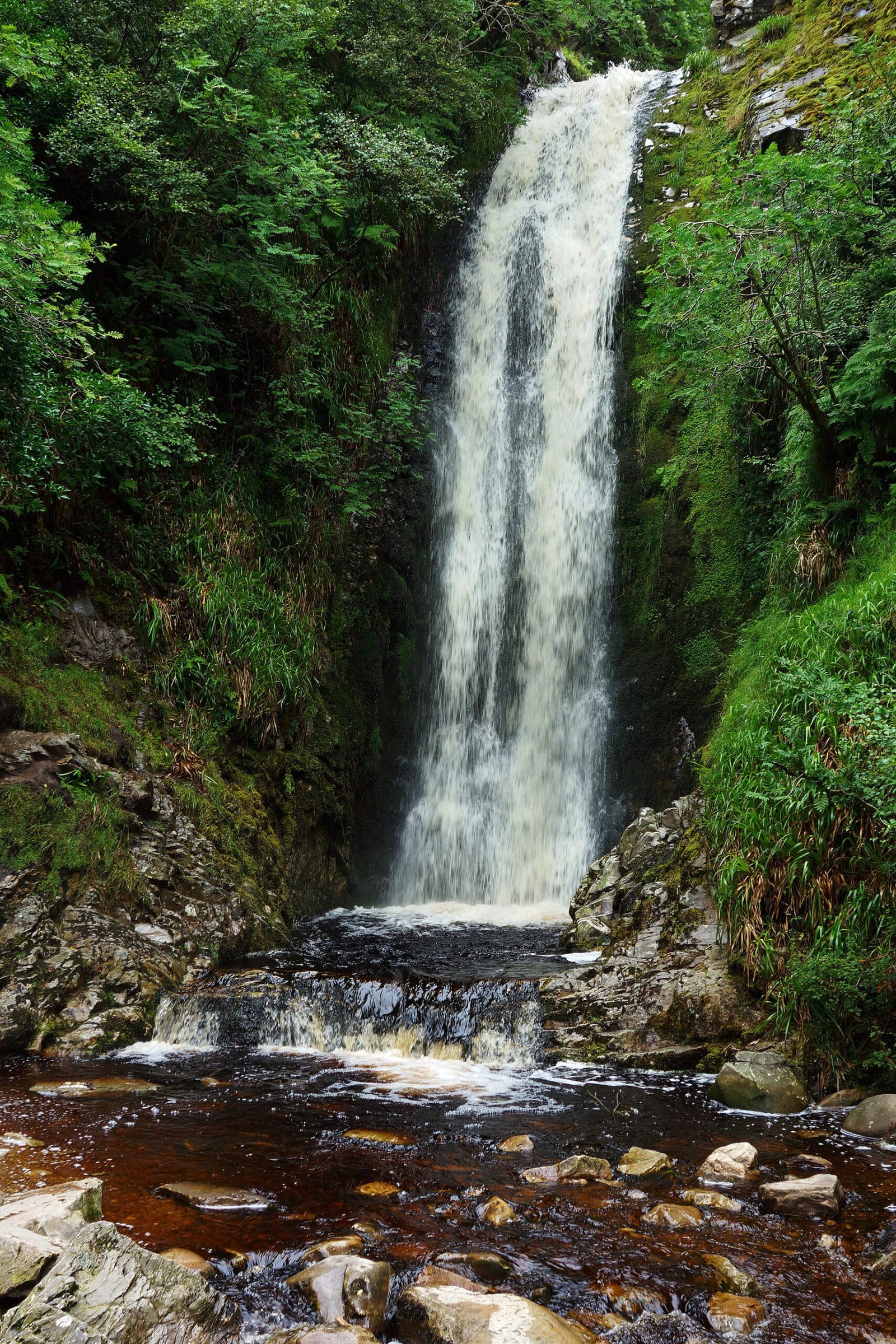
Glenevin is a steep-sided wooded cleft running back into the flank of Raghtin More, the mountain that shoulders over Clonmany and Urris. The stream drops through mature deciduous woodland into a plunge pool locally called Poll an Eas, which reads plainly as the pool of the waterfall. You will find more poetic translations offered online, and they contradict each other, so I would not lean on any of them.
The fall itself is around 40 feet, or 12 metres. That figure is disputed too, with some official listings saying 30 feet, but the higher number is what the property at the trailhead and the local press both use.
Flying from the US?
Most Americans pay too much to get to Ireland.
I send one email a week with the best fares from US airports into Dublin, Shannon and Belfast, plus what to actually do when you land. $14.99 for the year, refunded if it does not pay for itself.
The story: Clonmany, a book shrine, and a white dove
The village at the mouth of the glen is Clonmany, from Cluain Maine, the meadow of St Maine or possibly the meadow of the monks. Locals call it The Cross, after the crossroads it grew around. It is one of the younger villages in Inishowen. The travel writer Richard Pococke did not mention it in 1752, it first appears in published topographies around 1795, and the 1861 census gives it 112 inhabitants in 21 houses.
The older layer of the parish is ecclesiastical. St Columba is said to have founded a monastery here, and the parish produced the Miosach, an eleventh century book shrine now in the National Museum of Ireland in Dublin. That object is real and datable, and it is the strongest thread connecting Clonmany to the early church.
The Columba stories attached to the place are folklore, and worth telling as such. A cup-marked stone in Straid graveyard is said to bear the imprint of the saint’s knees. There is a holy well named for him at Binnion on the shore. And there is a well-developed legend explaining why the church stands at Straid rather than Binnion: a white dove kept undoing the builders’ work at Binnion and carrying the stones, mortar and timber up to the height at Straid. That one was collected from native Irish speakers here in 1937 and 1938 for the Schools Folklore Collection, which is a rather wonderful thing to know as you drive past.
The story of the path itself
This is the part I like best, because it is recent and it is entirely down to people who live here.
The walkway was the project of Doris Russo, an American from Rockford, Illinois, who passed through Inishowen in 1993 and bought The Glen House at the mouth of the glen in 1994. She set about making the waterfall reachable by families, and over years, with community help, the glen gained a trail, footbridges, picnic areas, gazebos and a car park. She sold the house in 2004.
Then on 22 August 2017 the Inishowen flash floods tore the walkway apart. The glen was shut for more than nine months. The Glenevin Development Group raised the money and rebuilt it, with new bridges, guard rails and benches, and the waterfall reopened on 17 June 2018. A plaque was unveiled to Doris Russo, who had died in August 2017.
The walk
Sport Ireland’s official trail record gives it as 0.7 km, 45 minutes, graded easy, with 50 metres of ascent. It is there and back rather than a loop. The surface is well-made gravel with timber drainage bars, waymarked with wooden posts, and the footbridges over the stream are wide and railed.
On accessibility, the honest version: it is gentle and steady rather than steep, with no significant steps, and people take buggies up it. But the gravel is medium-coarse, so narrow wheels struggle and a self-propelled wheelchair is a real effort. Buggy-friendly with a bit of work, not reliably wheelchair accessible.
There are fairy doors on the trees along the path, which is a modern touch for children rather than anything ancient, and it works beautifully on the under-sixes.
Getting there
- From Derry: around 48 km, allow 55 to 65 minutes, via either Quigley’s Point and Carndonagh, or Bridgend and the R238 through Buncrana.
- From Carndonagh: around 13 km, 15 to 20 minutes, on the R238 through Ballyliffin to Clonmany, then onto the Urris and Mamore road at the Centra and 1.2 km on.
- From Buncrana: around 19 km, 20 to 25 minutes north on the R238.
Clonmany is small and served thinly by bus, so a car makes this far easier. Compare car hire in Ireland here.
The final 1.2 km from Clonmany is an ordinary two-way rural road, but it is busier and faster than it looks, which matters if you end up in the overflow parking and have to cross it with children.
Parking and practicalities
- Admission: free. There are donation boxes and they go toward upkeep.
- Parking: free, roughly 20 spaces at the trailhead beside The Glen House, with overflow across the road about 50 metres toward Clonmany.
- The gate: the main car park sits behind a gated entrance and the times vary. If you are planning an early or late visit, ring ahead rather than assume.
- Toilets: reported on site near the entrance.
- Refreshments: a small kiosk has been reported at the entrance, and The Glen House has offered tea and scones, but do not count on it. Clonmany village is two minutes away and has proper options.
- Picnic areas and gazebos along the trail, with valley views.
- Dogs: not allowed. This is stated on the official Sport Ireland trail record and by Visit Inishowen. Most write-ups miss it, so do not drive here with the dog in the car.
- Phone signal: a steep wooded glen under a mountain. Expect it to drop out.
When to go
After rain, when the fall is at full volume. That is also when the stone, timber and gravel are at their most slippery, so wear something with grip. Morning or early evening for light and for quiet, because the small car park fills at midday in July and August.
One genuine caution: this glen was destroyed by a flash flood in 2017. The stream rises fast and hard. Do not walk it during or immediately after a severe weather warning.
Frequently asked questions
How long is the Glenevin Waterfall walk?
Sport Ireland’s official trail record gives it as 0.7km, 45 minutes, graded easy, with 50 metres of ascent. It is there and back rather than a loop, on well-made gravel with timber drainage bars, waymarked with wooden posts and wide railed footbridges over the stream.
Is Glenevin Waterfall free?
Yes, and so is the parking. There are donation boxes and they go toward upkeep. Roughly 20 spaces at the trailhead beside The Glen House, with overflow across the road about 50 metres toward Clonmany.
Are dogs allowed at Glenevin Waterfall?
No. This is stated on the official Sport Ireland trail record and by Visit Inishowen. Most write-ups miss it, so do not drive out with the dog in the car.
Is Glenevin Waterfall buggy friendly?
Yes, and people do take buggies up it. It is gentle and steady rather than steep, with no significant steps. The gravel is medium-coarse though, so narrow wheels struggle and a self-propelled wheelchair is a real effort.
When is the best time to visit Glenevin Waterfall?
After rain, when the fall is at its best. Be aware the main car park sits behind a gated entrance and the times vary, so ring ahead rather than assume if you are planning an early or late visit.
Is there a cafe at Glenevin Waterfall?
Do not count on it. A small kiosk has been reported at the entrance and The Glen House has offered tea and scones, but Clonmany village is two minutes away and has proper options. There are toilets reported on site near the entrance, and picnic areas and gazebos along the trail.
Nearby
- Mamore Gap, ten minutes up the road, and about as different an experience as you could ask for.
- Carrickabraghy Castle, out past Ballyliffin on the Isle of Doagh.
- Things to Do in Inishowen.
- Things to Do in Donegal.
Inishowen sits right on the border, and most people who come this far pair it with the north. Here is the full guide to things to do in Northern Ireland.
Getting here and where to stay
Glenevin Waterfall is a short walk off the road near Clonmany, about fifty minutes from Derry, and it pairs with Mamore Gap on the same run. There is no public transport worth the name on Inishowen, so a car is not a convenience here, it is the trip itself. If you are flying into Derry, Belfast or Dublin, compare hire prices before you land rather than taking what the airport desk offers you.
Derry is the practical base for most of the peninsula. It has the hotels, it has somewhere to eat after dark, and nearly everywhere on Inishowen is inside an hour and a half of it. If you would rather stay on the peninsula, Buncrana and Moville both have beds, but book early in summer because there are not many.
Every stop on the Inishowen 100
This guide is part of a series covering the peninsula stop by stop. Here is the rest of it:
- Malin Head, Ireland’s most northerly point.
- Five Finger Strand, the dunes and the sea stacks.
- Carrickabraghy Castle, the O’Doherty ruin on the rock.
- Doagh Famine Village, famine-era life, told on the spot.
- Kinnagoe Bay, where the Spanish Armada came ashore.
- Mamore Gap, the steepest road on the peninsula.
- Grianán of Aileach, the ring fort above two loughs.
- Fort Dunree, the fort that guarded Lough Swilly.
Pin this for later
Planning a trip? Save this to Pinterest so you can find it again.

Written by
Diana Greenlee
I live in County Down and write Tales of Irish Travel. After years living abroad I came home during Covid and started properly exploring the island. I write about the history and the story behind a place, not just the place. More about me.