

Five Finger Strand is the beach people mean when they say Donegal is wild. It sits at Lag, on the western shore of Trawbreaga Bay, in the last few miles of Ireland before Malin Head, and it is enormous, empty and slightly forbidding even on a good day.
Working out where this sits against everything else on the peninsula? It is a pin on my map of Inishowen, alongside every other place worth stopping at on the Inishowen 100.
Some links in this guide are affiliate links. If you book through one I may earn a small commission, at no extra cost to you. As an Amazon Associate I earn from qualifying purchases. I only link to things I would use myself.
It is also the subject of one claim that gets repeated everywhere and does not survive checking. I will come to that, because getting it right makes the real story better.
Coming from the other side of the border? There is no checkpoint, but the money, your phone and the speed limits all change. Read the guide to crossing between Ireland and Northern Ireland.
The five fingers
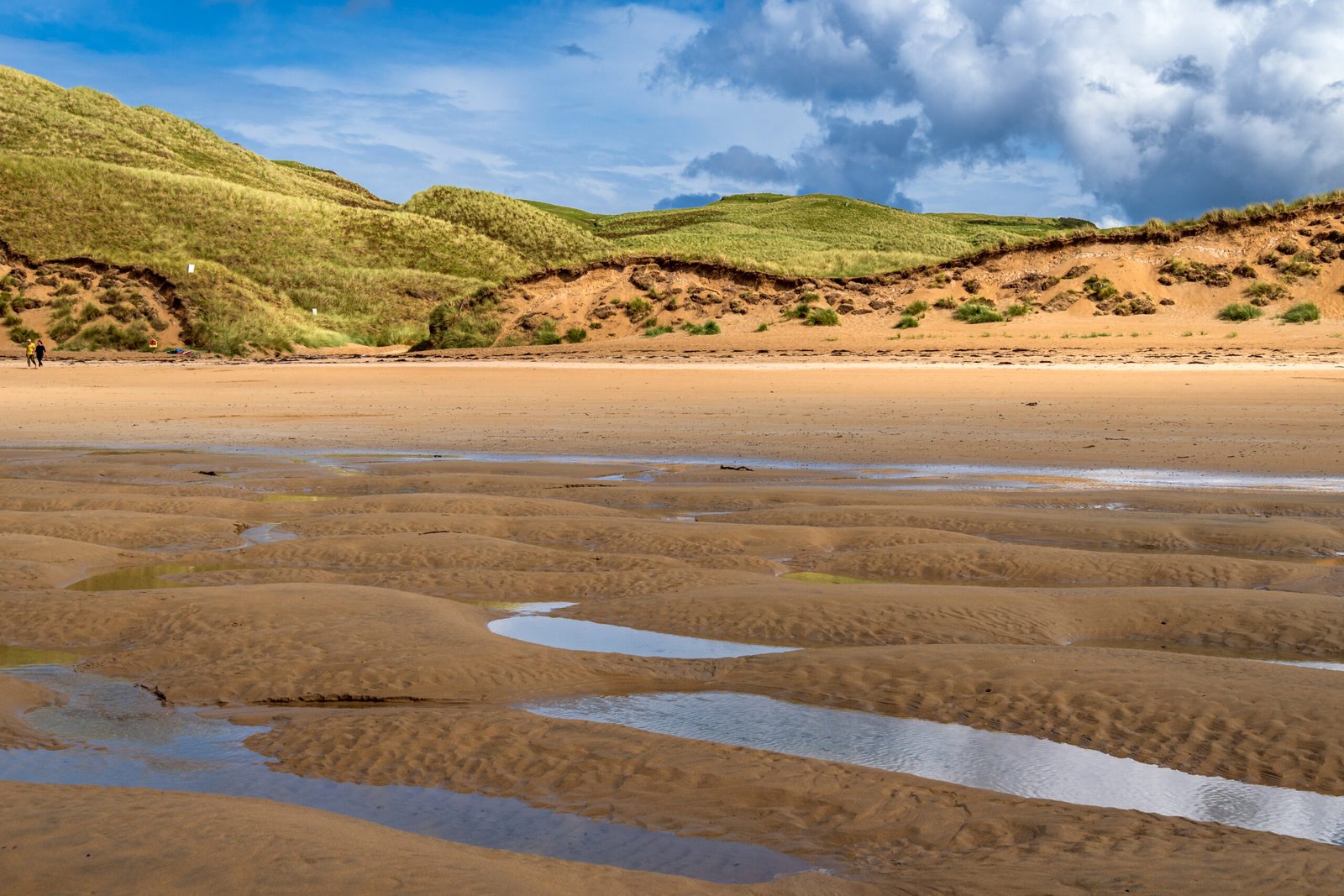
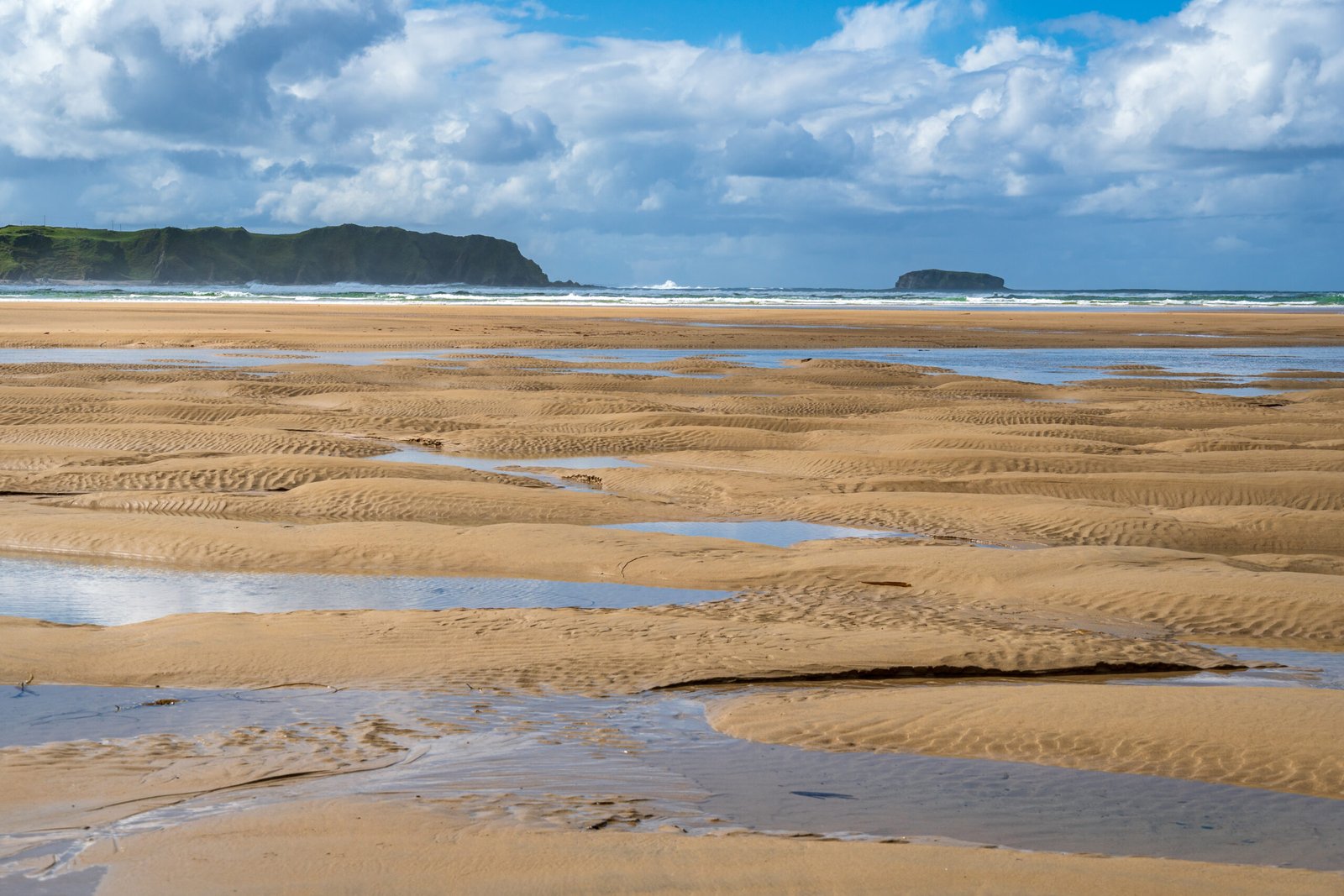
The name is the straightforward part. Five narrow sea stacks rise out of the water at the northern end of the strand, clearest at low tide, and they read unmistakably as fingers. That is the whole etymology, and every source agrees on it.
Flying from the US?
Most Americans pay too much to get to Ireland.
I send one email a week with the best fares from US airports into Dublin, Shannon and Belfast, plus what to actually do when you land. $14.99 for the year, refunded if it does not pay for itself.
The dunes: what is actually true
Official Irish tourism copy states that the dunes here reach up to 30 metres and are among the highest in Europe. Discover Ireland prints it. The official Wild Atlantic Way site prints it. Visit Inishowen hedges it slightly to “among the highest marram grass dunes in Europe.”
It is not right. The Dune of Pilat in France stands at 106.6 metres and is Europe’s tallest. The marram-stabilised dunes of the Curonian Spit and the Polish coast at Slowinski also comfortably exceed Five Finger’s. Even the narrower marram-grass version of the claim does not hold.
Here is the version that is both true and, I think, better. This is one of the tallest and least disturbed dune systems in Ireland, held together by marram grass, and 30 metres is genuinely exceptional in an Irish context: the national dune monitoring survey describes Irish marram dunes as sometimes reaching 15 to 20 metres. Standing at the bottom of them, that is what it feels like. You do not need France to be smaller for this place to be extraordinary.
The dunes sit within the North Inishowen Coast Special Area of Conservation, so keep to established paths and off the faces.
And do not climb them
There are signs everywhere asking people to stay off the dunes, because marram-held sand comes apart underfoot and does not knit back together. People climb them anyway. I have watched plenty of them do it, and a fair few get into bother getting back down.
The chapel behind the dunes
Just inland is St Mary’s, Lagg, a T-plan chapel built in 1784. The National Inventory of Architectural Heritage calls it an evocatively sited early post-Penal Catholic chapel which, according to Rowan’s 1979 survey, was the first in Inishowen. Gravemarkers on the site date to at least 1719, and there is an ancient font outside, locally said to have come from St Mura’s monastery at Fahan.
You will see it described as Ireland’s oldest Catholic church in continuous use. I could not find evidence for that, and the NIAH makes no such claim. What it certainly is, is a genuinely early post-Penal survival in a spectacular position, and it is worth the five minute detour.
Do not swim here
This is the most consistent finding across every source, and it deserves its own heading. Five Finger Strand sits at the mouth of a tidal estuary on Trawbreaga Bay, and the currents are treacherous. Visit Inishowen cites dangerous undercurrents and rip tides. Discover Ireland discourages swimming outright.
There is no lifeguard and no Blue Flag here. Donegal County Council staffs lifeguards only on Blue Flag beaches plus Rathmullan, from 1 June to 15 September, and Five Finger is on neither list. The nearest lifeguarded beaches in Inishowen are Culdaff and Stroove.
The other thing to watch is the tide itself. It is a wide, flat strand at an estuary mouth, and the bay drains and fills fast. Check the times before you walk out toward the stacks.
What it actually looks like when you are standing there
Here is the trap. The water does not look rough. On the day I was there it looked no choppier than any other beach, which is exactly why people get caught out by it. I stayed well back from the water’s edge and never felt I was missing anything, because there is so much beach to walk that you are not constantly glancing over your shoulder.
Go when the tide is out. We walked the whole length of it with the tide out and it was the best version of the place.
Getting there
- From Derry: roughly 55 to 65 km, allow around an hour and a quarter, north through Muff and Quigley’s Point, then inland to Carndonagh and the R238 to Malin town, then the signed local road to Lag.
- From Malin: about 10 minutes.
- From Carndonagh: about 20 minutes.
- From Moville: across the peninsula via Carndonagh, 45 to 55 minutes.
There is no public transport to Lag, so you will need a car. Compare car hire in Ireland here.
The final local road is narrow with passing places and blind bends, but it is not steep and there are no hairpins. Fine for a car, manageable for a campervan with care. The constraint is the parking rather than the road, so leave the caravan at the site.
Parking and practicalities
- Admission: free, open access.
- Parking: small, informal and free, at the end of the road behind the dunes. It is limited. At busy times, the church car park up the road is the sensible alternative and it is a short walk down.
- Getting to the sand: the parking area is at beach level behind the dunes, so it is a matter of metres, over loose sand and uneven ground.
- Accessibility: poor. Sandy, uneven terrain and no made surface.
- Toilets: none.
- Dogs: allowed under control. Not a Blue Flag beach, so the summer Blue Flag dog restrictions do not apply, but the general Donegal rule does.
- Phone signal: assume unreliable this far north.
How long to allow, and when
Around two hours does it properly: the length of the strand, the stacks at low tide, and the chapel. Low tide is the time to come, both for the fingers and for the sheer scale of sand it exposes. Late evening light off the Atlantic is the pick.
Frequently asked questions
Can you swim at Five Finger Strand?
No. This is the most consistent finding across every source. The strand sits at the mouth of a tidal estuary on Trawbreaga Bay and the currents are treacherous, with dangerous undercurrents and rip tides. There is no lifeguard and no Blue Flag. Walk it, do not swim it.
Are the dunes at Five Finger Strand the highest in Europe?
No, and official tourism copy gets this wrong. Discover Ireland and the Wild Atlantic Way site both print the claim. The Dune of Pilat in France is 106.6 metres and is the tallest in Europe. The dunes here are big and worth seeing, but they are nowhere near a European record.
Is Five Finger Strand free to visit?
Yes. Open access, no admission, and the small informal car park behind the dunes is free too. It is limited in size, so at busy times the church car park up the road is the sensible alternative.
How long do you need at Five Finger Strand?
Around two hours does it properly: the length of the strand, the sea stacks at low tide, and the chapel. Come at low tide, both for the fingers and for the scale of sand it exposes.
Can you bring a dog to Five Finger Strand?
Yes, under control. It is not a Blue Flag beach, so the summer Blue Flag dog restrictions do not apply, but the general Donegal rules do.
Are there toilets at Five Finger Strand?
No. There are none, and the phone signal is unreliable this far north, so do not count on either.
Nearby
- Malin Head, twenty minutes further north, and the natural pairing.
- Carrickabraghy Castle, round on the Isle of Doagh.
- Things to Do in Inishowen.
- Things to Do in Donegal.
Inishowen sits right on the border, and most people who come this far pair it with the north. Here is the full guide to things to do in Northern Ireland.
Getting here and where to stay
Five Finger Strand is forty minutes from Derry and there is nothing at the beach itself, so you are staying somewhere and driving out. There is no public transport worth the name on Inishowen, so a car is not a convenience here, it is the trip. If you are flying into Derry, Belfast or Dublin, compare hire prices before you land, because the airport desks are the dearest way to do it.
Derry is the practical base for most of the peninsula. It has the hotels, it has somewhere to eat after dark, and almost everywhere on Inishowen is inside an hour and a half of it. If you would rather be on the peninsula itself, Buncrana and Moville both have places to stay, but book early in summer because there are not many of them.
Every stop on the Inishowen 100
This guide is part of a series covering the peninsula stop by stop. Here is the rest of it:
- Malin Head, Ireland’s most northerly point.
- Carrickabraghy Castle, the O’Doherty ruin on the rock.
- Doagh Famine Village, famine-era life, told on the spot.
- Kinnagoe Bay, where the Spanish Armada came ashore.
- Mamore Gap, the steepest road on the peninsula.
- Glenevin Waterfall, the easy walk near Clonmany.
- Grianán of Aileach, the ring fort above two loughs.
- Fort Dunree, the fort that guarded Lough Swilly.
Pin this for later
Planning a trip? Save this to Pinterest so you can find it again.


Written by
Diana Greenlee
I live in County Down and write Tales of Irish Travel. After years living abroad I came home during Covid and started properly exploring the island. I write about the history and the story behind a place, not just the place. More about me.