
The Great Famine is the event that shaped modern Ireland more than any other, and yet most of us learned it as dates and numbers rather than something you can stand inside. On a windswept peninsula in the far north of Donegal, you can do exactly that. Doagh Famine Village turns the story off the page and into thatched cottages, real family history, and the people who actually lived it.
Working out where this sits against everything else on the peninsula? It is a pin on my map of Inishowen, alongside every other place worth stopping at on the Inishowen 100.
Some links in this guide are affiliate links. If you book through one I may earn a small commission, at no extra cost to you. As an Amazon Associate I earn from qualifying purchases. I only link to things I would use myself.
If you’ve followed along on TikTok for the history, this is one you can go and walk through yourself. Here’s everything you need to plan a visit, what to expect, opening times and prices, where to stay nearby for every budget, and how to build it into a proper Inishowen day out.
Crossing the border? Two currencies, two sets of speed limits and a hire car insurance trap that catches people out. Here is everything that actually changes when you cross between Ireland and Northern Ireland.
What is Doagh Famine Village?
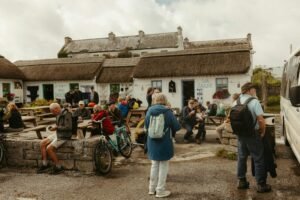
Doagh Famine Village is an open-air “living museum” on the Isle of Doagh in north Inishowen, County Donegal. Rather than display cases behind glass, it recreates everyday Irish life from the Great Famine of the 1840s right through to recent decades, using original thatched cottages and life-sized scenes. It’s one of Donegal’s most popular heritage attractions, and one of the most human introductions to the Famine anywhere in Ireland.
Flying from the US?
Most Americans pay too much to get to Ireland.
I send one email a week with the best fares from US airports into Dublin, Shannon and Belfast, plus what to actually do when you land. $14.99 for the year, refunded if it does not pay for itself.
The history behind Doagh Famine Village
When the potato blight struck in the 1840s, remote coastal communities like the Isle of Doagh were among the hardest hit, isolated, reliant on a single crop, and at the mercy of landlords who could evict a family from its home in an afternoon. This stretch of Inishowen lived that history directly.
What makes the Donegal famine village different from a conventional museum is that it isn’t a reconstruction built by strangers. It grew up around an actual home, one lived in by the Doherty family right up until the 1980s, and the tours are led by people with a genuine, personal connection to the place. The result is history told the Irish way: heavy and light in the same breath, hardship threaded with humour.
What to expect at Doagh Famine Village
What the visit is actually like
This is not a museum where you wander round reading boards, and that is the whole point of it.
You come in near the café and they bring you into a room and sit you down, and a man talks to you. Not a script. He talks about what things were actually like in Ireland, about wakes, and about where the phrases we all still use came from and what they originally meant. It feels closer to sitting with a friend who happens to know all this than to being given a tour. Things get handed round as he goes, a drop of poitín and some of the seaweed, so it is interactive without being the forced kind of interactive.
Then you go into the house. It is his house. The man who owns the place lives there, and he talks you through it for another twenty minutes or so. I have not been in anything else quite like it.
After that you are let loose to walk the rest of the site yourself.
How long it takes
Roughly thirty minutes in the introduction and twenty in the house, so call it a good hour with the man himself, then another half hour walking round the rest. Mine did not stop and read every panel. If you are the sort who reads everything, add an hour.
Children, and dogs
Mine loved it, and they are far enough apart in age that I had expected one of them to be bored. Neither was.
It is also dog friendly, which is rarer around here than it should be, so mine came in with me.
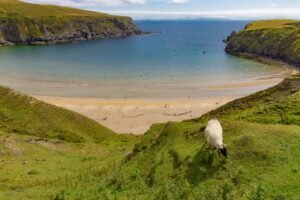
And you can see Five Finger Strand from the site, so it is a good spot for photographs as well as everything else.
Doagh Famine Village opening times, prices and location
Doagh Famine Village opening times
The main famine experience is seasonal, running roughly from mid-March to mid-October, daily, with last entry in the late afternoon (around 4pm). It then reopens for a special Christmas season (see below). Always confirm current opening times on the official website before you travel, hours shift with the season.
Ticket prices
Tickets are around €16 for adults and €10 for children (under 16), with under-4s free, and the price includes the guided tour plus a tea or coffee.
Where is Doagh Famine Village? The Isle of Doagh, Inishowen
You’ll find it at Lagacurry, Isle of Doagh, Ballyliffin, Inishowen, County Donegal, Eircode F93 PK19. The “island” is really a peninsula linked by a causeway, just outside the village of Ballyliffin on the Wild Atlantic Way.
How to get to Doagh Famine Village
It sits on the Inishowen 100 scenic loop. It’s about 40 minutes from Derry and roughly an hour from Letterkenny, so it pairs naturally with a wider Inishowen road trip. You’ll want a car, public transport this far north is limited.
To rent a car click the link for the best deals.
Visiting Doagh Famine Village at Christmas (Santa’s Island)
Here’s a lovely twist: outside the main season, Doagh Famine Village transforms into “Santa’s Island” for Christmas, a festive experience that draws big crowds to this corner of Inishowen each year. If you’re visiting Donegal in December, it’s a very different (and very family-friendly) reason to come. Christmas dates and tickets are separate from the summer season, so check the official site for the year’s schedule.
Frequently asked questions
How much does Doagh Famine Village cost?
Around €16 for adults and €10 for children under 16, with under-4s free. The price includes the guided tour plus a tea or coffee.
When is Doagh Famine Village open?
The main famine experience is seasonal, running roughly mid-March to mid-October, daily, with last entry in the late afternoon, around 4pm. It then reopens for a Christmas season. Hours shift, so confirm on the official site before you travel.
How long does Doagh Famine Village take?
Roughly thirty minutes in the introduction and twenty in the house, so call it a good hour with the man himself, then another half hour walking round the rest. Add an hour if you are the sort who reads every panel.
Is Doagh Famine Village dog friendly?
Yes, which is rarer around here than it should be. Mine came in with me.
Is Doagh Famine Village good for children?
Mine loved it, and they are far enough apart in age that I had expected one of them to be bored. Neither was.
Where is Doagh Famine Village?
Lagacurry, Isle of Doagh, Ballyliffin, Inishowen, County Donegal, Eircode F93 PK19. The island is really a peninsula linked by a causeway, just outside Ballyliffin on the Wild Atlantic Way and on the Inishowen 100 loop. About 40 minutes from Derry.
Books about the Great Hunger worth reading
Doagh gives you the shape of it in an afternoon. If you want the detail, these four are the ones I keep going back to, and between them they cover the argument as well as the events.
The Great Hunger: Ireland 1845-1849, Cecil Woodham-Smith. Published in 1962 and still the one most people start with. Narrative history, very readable, and it was the book that put the famine back into popular consciousness in Britain. Historians have argued with parts of it ever since, which is worth knowing going in.
Atlas of the Great Irish Famine, edited by John Crowley, William J. Smyth and Mike Murphy. Cork University Press. This is the serious one: maps, workhouse data, population loss county by county, and essays from dozens of historians. Heavy in every sense, and the only book here that will show you what happened in your own parish.
The Graves Are Walking, John Kelly. Focuses on the decision-making in London and the machinery of relief. Good on why the response was what it was, rather than simply that it failed.
The Famine Plot, Tim Pat Coogan. The most polemical of the four, arguing the case that the response amounted to something closer to deliberate policy. Contested by other historians, and worth reading alongside the Atlas rather than instead of it.
If you only take one, take the Atlas. If you want to be gripped rather than informed, take Woodham-Smith.
Things to do near Doagh Famine Village
This is where a famine visit becomes a proper day out. Within a short drive you’ve got some of the most dramatic scenery in the country and there are plenty of things to do in Donegal.
Malin Head
The most northerly point of mainland Ireland, and worth the drive for the views alone, wild, windswept and unforgettable.
Five Finger Strand and Pollan Bay
A wild, dune-backed beach right beside the village, with some of the highest dunes in Europe and huge Atlantic surf.
Carrickabraghy Castle
A 16th-century ruin perched on the rocks on the Isle of Doagh itself, atmospheric and free to wander.
Ballyliffin
The closest village and the handiest base, with pubs, food, beaches and the famous Ballyliffin links golf courses.
Where to stay near Doagh Famine Village: hotels and accommodation for every budget
Ballyliffin is the natural base, a few minutes from the village and well placed for Malin Head and the beaches. Here are real options across every budget, from spa hotels to self-catering cottages.
Luxury hotels and spa stays
Ballyliffin Lodge Hotel & Spa
A newly refurbished 4-star hotel and spa overlooking Pollan Bay, beside the golf club, the premium choice in the area, and a popular pick for a treat or a spa break.
Ballyliffin TownHouse Boutique Hotel
A stylish, family-run boutique hotel right in the village, within walking distance of the pubs and restaurants.
Family-friendly hotels near Doagh Famine Village
Ballyliffin Hotel
A warm, family-run hotel with a restaurant, free parking and a genuine local feel, reliable and central for families.
Redcastle Oceanfront Golf & Spa Hotel
A little further east in Inishowen, but a strong family option with a pool, spa and oceanfront setting if you want resort facilities.
Budget stays and B&Bs
Madra Rua Organic Accommodation
A well-reviewed B&B close to Doagh Famine Village, handy and friendly, a great-value base.
Doherty’s Country Accommodation
Comfortable, welcoming country accommodation in Ballyliffin, popular with walkers and golfers.
Sandrock Holiday Hostel (Malin Head)
For the tightest budgets or solo travellers, this hostel up near Malin Head is a friendly, no-frills option.
Self-catering cottages and holiday homes
Ballyliffin Beach Houses
Modern 2- and 4-bedroom self-catering houses near the beach, ideal for families or groups who want space and a kitchen.
Sissly’s Cottage, Isle of Doagh
A self-catering cottage right on the Isle of Doagh, about five minutes from the visitor centre, the closest you can stay to the village itself.
Where to eat near Doagh Famine Village
There’s the on-site café for a light bite, and Ballyliffin and Malin have a handful of pubs and cafés for a proper lunch or dinner, Nancy’s Barn near Ballyliffin is a well-loved spot for daytime food. Seafood this close to the Atlantic is rarely a bad shout.
Doagh Famine Village reviews: is it worth visiting?
It consistently earns warm reviews, and for good reason, visitors single out the guides and the storytelling as what lifts it above an ordinary museum. It’s emotional and honest, but handled with warmth and humour, and it’s genuinely good for families. If you’re weighing it up against other Donegal stops, it’s one of the most memorable, precisely because it’s so personal.
Final thoughts: planning your visit to Doagh Famine Village
Doagh Famine Village is the rare history stop that stays with you, partly the story, partly the people telling it, wrapped in some of the most beautiful landscape Ireland has. Come in season (or at Christmas for Santa’s Island), give it a couple of hours, pair it with Malin Head and the beaches, and pick a base in Ballyliffin to make a weekend of it.
Doagh is one of several Great Famine sites worth visiting across Ireland. See our complete guide to Ireland’s Great Famine sites.
I’m telling these stories one at a time on TikTok, then writing up how to visit each place here.
Have you been to Doagh, or is it on your list? Let me know in the comments.
Doagh is twenty minutes from the border. If you are combining the peninsula with the north, here is the full guide to things to do in Northern Ireland and to Halloween in Northern Ireland.
Every stop on the Inishowen 100
Doagh is one stop on a peninsula full of them. Here is the rest of the series:
- Things to Do in Inishowen, the full peninsula guide and the route itself.
- Carrickabraghy Castle, a kilometre away on the same Isle of Doagh.
- Malin Head, Ireland’s most northerly point.
- Five Finger Strand, the dunes and the sea stacks.
- Kinnagoe Bay, where the Spanish Armada came ashore.
- Mamore Gap, the steepest road on the peninsula.
- Glenevin Waterfall, the easy walk near Clonmany.
- Grianán of Aileach, the ring fort above two loughs.
- Fort Dunree, the fort that guarded Lough Swilly.

Written by
Diana Greenlee
I live in County Down and write Tales of Irish Travel. After years living abroad I came home during Covid and started properly exploring the island. I write about the history and the story behind a place, not just the place. More about me.
Great content! Keep up the good work!
Pingback: Things to Do in Donegal: The Ultimate Guide